NewFoS Education Overview
This page provides an overview of New Frontiers of Sound (NewFoS) Education and Broader Participation initiatives, which bring research, learning, and mentoring together in intentional ways. The sections below highlight:
- Convergence Education – how educational activities are integrated with research and designed to prepare participants for future opportunities.
- Mentoring Ecosystem – the structure of mentoring across students, postdocs, faculty, and staff, and how collaboration extends across institutions.
- Theoretical and Methodological Foundations – the guiding frameworks and approaches that shape the design and direction of our programs.
These areas collectively show how NewFoS builds connections between education, mentoring, and research to strengthen both individual growth and the broader scientific community.
Integrative strategy
The NewFoS Education and Broader Participation (E&BP) program is built around four interconnected activities that integrate education, workforce preparation, and knowledge transfer with research. These activities include:
- the development of an authoritative, context-based Topological Acoustics (TA) textbook and accompanying digital resources to support instruction and establish a foundation for the TA field;
- a Community College Workshop that provides accessible entry points into TA pathways and introduces students to careers in the TA workforce;
- the Research Experience and Mentoring (REM) program, which cultivates the next generation of TA researchers by engaging undergraduates in immersive research experiences paired with structured mentoring;
- Leadership Programs that prepare participants to become leaders in science and society by strengthening professional skills, mentoring capacity, and leadership abilities—critical components of sustaining a skilled TA workforce.
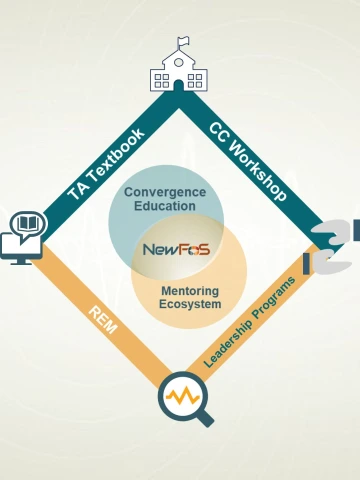
Together, these efforts form a convergence education program that connects researchers, educators, and students, supports knowledge transfer within NewFoS and across the broader scientific community, and sustains a mentoring ecosystem that integrates research with workforce development goals.
Convergence Education
Center Convergence Education objective. NewFoS obejective is to graduate students and postdocs as technologists, researchers, leaders, and policymakers who are well-versed in the broad science, technology, and societal aspects of the new science of sound. NewFoS will produce a competitive workforce that contributes to society through team-based science-of-sound and engineering solutions, develops marketable products for US economic growth and positive societal impacts, and drives research to advance revolutionary sound applications.
Mentoring Ecosystem
Mentoring Ecosystem objective. NewFoS pursues the following Education and Broader Participation objective: by adopting the methods and principles of educational excellence, NewFoS is creating a multi-institution, transferable Mentoring Ecosystem to develop a resilient culture and recruit, retain, and sustain a competitive workforce. The Mentoring Ecosystem emphasizes richer professional relationships, successful educational experiences, and stronger team dynamics for students, postdocs, and early-career scientists in a collective of innovation. This strategy complements our Convergence Education by: (1) positively impacting mentees and ensuring resilience; (2) revealing and preparing career paths; and (3) building professional skills.


The NewFoS Education Framework
Integrating an Asset-Based Mindset with the LINCSS Framework: Linking Inclusive Narratives to Create STEM Synergy (LINCSS) 5P domains and four complementary instructional approaches, enabling aligned implementation and evaluation across diverse New Frontiers of Sound (NewFoS) Science and Technology Center programs.
Instructional Approaches
- BSCS 5E Instructional Model: Engage, Explore, Explain, Elaborate, Evaluate; supports inquiry cycles that help students construct understanding through experimentation and reflection.
- Entering Research Curriculum: Offers structured mentoring and research skill development that strengthens self-efficacy, identity, and belonging.
- Place-Based Learning: Grounds education in the physical, cultural, and community contexts where learning occurs, connecting STEM concepts to local environments and real-world applications.
- Student-Centered Mentoring: Frames mentoring as reciprocal and evidence-based, grounded in empathy, communication, and reflection.
Together, these models form a Mentoring Ecosystem within a Convergence Education approach, where scientific inquiry, personal development, and social context intersect to prepare students for purposeful, collaborative, and innovative careers.
From Independent Programs to a Unified Framework
After the first years of implementing the Community College Workshop, Student-Centered Leadership modules, and the REM program, assessment data and program experience revealed clear and consistent threads across these initiatives, despite their independent development and structural complexity.
In response, the Education and Broadening Participation team convened to synthesize these insights into a unified framework that intentionally connects and guides all Center education programs.
- Community College Workshop
- Foundational Topological Acoustics engagement for community college learners.
- Student-Centered Leadership
- Modules supporting identity and professional development.
- REM Program
- Research Experience and Mentoring for undergraduate students.
- Topological Acoustics Textbook
- A modular, inquiry-driven curricular ecosystem connecting foundational knowledge, conceptual understanding, and research participation.
The Asset-Based Mindset
We began with what is central to all programs and what we seek to cultivate: students. Research on student development indicates that adopting an Asset-Based mindset grounded in established educational theory is critical to building effective STEM learning environments that support student success, identity development, and persistence.
The Asset-Based mindset serves as the organizing principle of this framework, shaping how all approaches are selected, integrated, and enacted across programs. Using this framework, we recognize the strengths, experiences, and cultural wealth that all individuals connected to the Center bring, fostering confidence, belonging, and innovation.
No single member or student shares the same background or experiences; rather, there exists a diversity of academic, cultural, and experiential knowledge that creates a robust foundation for innovation, creativity, and growth.
What Asset-Based Thinking Cultivates
- Recognition of individual strengths and cultural wealth
- Confidence and sense of belonging in STEM spaces
- Innovation through diverse perspectives
- Inclusive learning environments for all learners

Looking Beyond the Artifact
How an archaeological perspective became a framework for understanding people.
The framework used throughout NewFoS emerged through the collaborative work of Sara Chavarria and Cory Knox. While working with STEM programs, Chavarria observed that professionals often focused on explaining their work without considering the broader experiences of the students they were trying to mentor. She sought a way to help students understand not only the science around them, but also the people, relationships, and experiences shaping their development.
Drawing on her background as a professional archaeologist and lithic specialist, Chavarria approached this challenge through a familiar lens. Archaeologists rarely reconstruct the past through written records alone. Instead, they interpret communities by examining the traces people leave behind. A projectile point, for example, is more than a stone tool—it is evidence of the people who created it, the environment in which they lived, the needs they sought to meet, the practices they developed, and the expertise they cultivated.
As she reflected on this process, Chavarria found herself returning to the same fundamental questions:
- Who were the people?
- Where did they live?
- What needs shaped their decisions?
- What practices did they develop?
- What expertise made those practices possible?
These questions revealed that artifacts tell stories far larger than the objects themselves. They reveal the relationships between people, place, human needs, practice, and expertise that define a community.
“Technology is not technology for technology’s sake. It exists to serve people, places, and communities.” Chavarria to REM students, 2026
The same perspective extends beyond archaeology. Just as archaeologists look beyond artifacts to understand ancient communities, educators can look beyond grades, research projects, and technical skills to better understand the students developing behind them. The questions that reveal the story of a community can also illuminate the development of a scientist, engineer, or future professional.
The LINCSS 5P Framework
This mindset informs how we design and support learners’ STEM and NewFoS identity development. We frame this process using the LINCSS 5P framework: People, Personal, Place, Practice, and Profession.

Making Identity Development Visible and Measurable
We posit that intentional engagement across these domains strengthens learners’ sense of belonging and supports their recognition as STEM practitioners. By explicitly integrating and labeling programs and workshops with these domains, identity development becomes visible, structured, measurable, and adaptable for ongoing evaluation.
Student-Centered Mentoring
Developmental relationships supporting academic and personal growth.
Place-Based Learning
Situating STEM education within real-world, community contexts.
Entering Research Curriculum
Structured scaffolding for undergraduate research experiences.
BSCS 5E Instructional Model
Inquiry-based learning through five structured phases.


Student-Centered Mentoring & Place-Based Learning
Entering Research & the BSCS 5E Model
An Integrated, Counterbalancing System
As illustrated in the framework wheel, these approaches are not implemented in isolation. Instead, they are intentionally layered and integrated, allowing each approach to activate multiple 5P domains simultaneously. This design ensures that no single aspect of STEM identity development is privileged at the expense of others.
Learning experiences are co-constructed as interconnected systems, where mentoring relationships, contextualized learning, structured research experiences, and inquiry-based instruction collectively support the development of well-rounded STEM practitioners.
This integrated structure intentionally counterbalances the tendency of STEM education to prioritize technical practice, ensuring equal attention to relational, contextual, and identity-based dimensions of learning. This ensures that learners engage not only in what they do as scientists, but in who they are, where they are situated, and how they relate to the broader impacts of their work.
References
Branchaw, J. L., Pfund, C., & Rediske, R. (2010). Entering Research: A Facilitator's Manual. W. H. Freeman.
Brueggemann, A. (2022). Student-centered mentoring: Keeping students at the heart of new teachers' learning. Corwin Press.
Bybee, R. W., Taylor, J. A., Gardner, A., Van Scotter, P., Carlson Powell, J., Westbrook, A., & Landes, N. (2006). The BSCS 5E Instructional Model: Origins and Effectiveness. BSCS.
Carlone, H. B., & Johnson, A. (2007). Understanding the science experiences of successful women of color: Science identity as an analytic lens. Journal of Research in Science Teaching, 44(8), 1187–1218.
Chavarria, S. P., & Knox, C. (2023). Linking Inclusive Narratives to Create STEM Synergy (LINCSS): A Framework for Culturally Responsive STEM Education and Engagement.
Espinoza, O. (2011). Solving the equity–equality conceptual dilemma: A new model for analysis of the educational process. Educational Research, 53(3), 263–275.
Gruenewald, D. A. (2003). The best of both worlds: A critical pedagogy of place. Educational Researcher, 32(4), 3–12.
Higgins, M. C., & Kram, K. E. (2001). Reconceptualizing mentoring at work: A developmental network perspective. Academy of Management Review, 26(2), 264–288.
Kram, K. E. (1985). Mentoring at work: Developmental relationships in organizational life. Scott, Foresman.
Ladson-Billings, G. (1995). Toward a theory of culturally relevant pedagogy. American Educational Research Journal, 32(3), 465–491.
National Academies of Sciences, Engineering, and Medicine. (2017). Undergraduate research experiences for STEM students: Successes, challenges, and opportunities. National Academies Press.
Page, S. E. (2007). The difference: How the power of diversity creates better groups, firms, schools, and societies. Princeton University Press.
Strayhorn, T. L. (2012). College students' sense of belonging: A key to educational success for all students. Routledge.
Yosso, T. J. (2005). Whose culture has capital? A critical race theory discussion of community cultural wealth. Race Ethnicity and Education, 8(1), 69–91.
License & Recommended Citation
Creative Commons Attribution 4.0 International
This work is licensed under a Creative Commons Attribution 4.0 International License (CC BY 4.0). You may share and adapt this material for any purpose, provided appropriate attribution is given.
Recommended citation:
The NewFoS Education Framework © 2026 by New Frontiers of Sound Science and Technology Center, University of Arizona is licensed under CC BY 4.0